
by Lauren Dockery, Director of Children & Youth Ministries
It’s 9:27 a.m. on Sunday morning. During a quiet pause in the sermon, a baby’s giggle echoes through the nave, and then a school-aged child skips up the side aisle into the narthex. How do you react?
Many of us chuckle to ourselves or glance around to smile at the kids. Some cringe with sympathetic embarrassment for the parents. Others lean forward to keep our focus on the liturgical action.
The parents of the noise maker or the wiggler may have an even stronger reaction: scooping up the kid or quickly tiptoeing after them, praying that it really wasn’t that distracting, nervously reassuring themselves, “My child is welcomed in this space. It is church, after all. Right?”
Where is the energy coming from? Our 9 a.m. service is attracting new families, and we have welcomed new babies into the community. In the last two years, we’ve added more than 30 children to our rosters of kids who worship here semi-regularly.
If you’ve worshipped at St. Paul’s this year, I know you are familiar with the coos, wiggles, thumps, and pitter-patters of children participating. This year, the 9 a.m. service was livelier than I’ve ever seen.
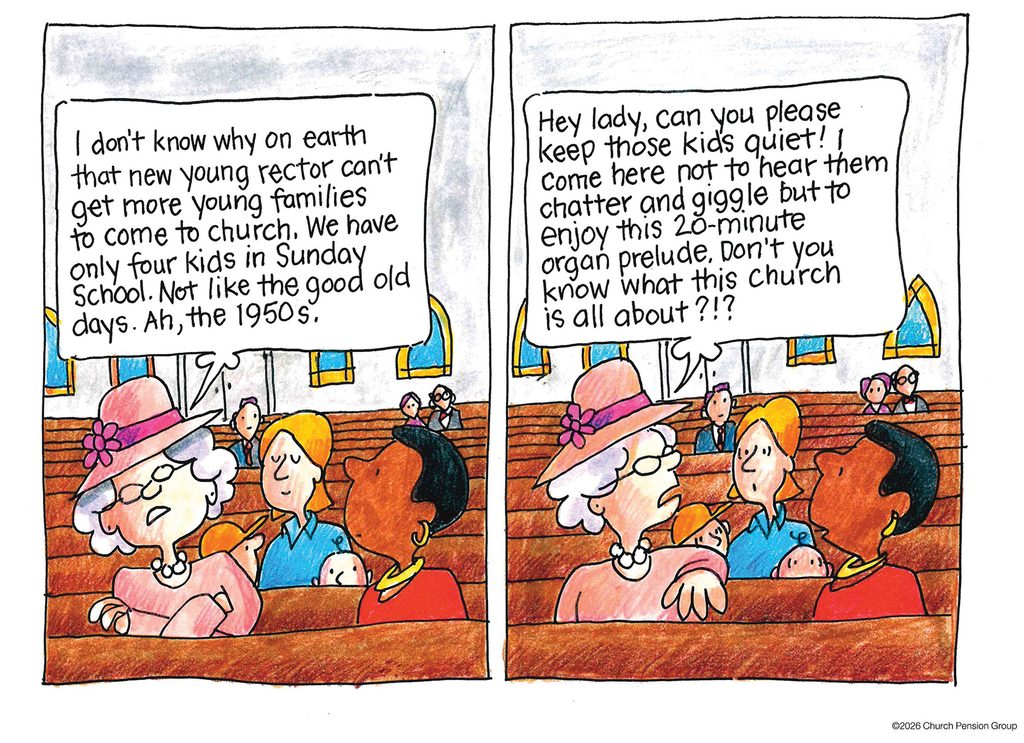
You might be thinking, “40 years ago, hundreds of children attended St. Paul’s every Sunday, and back then, the services were quiet! There’s got to be more to it.” There is. Two particular changes in parenting culture seem to be at play.
First, some parents with very young children like to bring the kids to the service instead of sending them to childcare. And this isn’t just a church trend. Younger children, ages zero to five, are present and active in more settings than ever before. In 2025, Forbes posted an article about the growing number of toddlers at fine dining restaurants.1 Bloomberg News recently wrote about changes in the vacation industry, as more families with little ones travel to luxury vacation spots.2 Even at a local bar on a Saturday afternoon in Cleveland Heights, you’re as likely to spill a package of crayons or knock over a Hot Wheels car as you are to break a glass or spill a drink.
According to Pew Research, modern parents prioritize quality time with their children and value a strong work-life balance. This includes socializing and community life, like church.3 But these families face a challenge. In 2025, more than half of couples with children had two parents working full time. In 1975, it was less than a third. Sixty percent of full-time working parents say they spend too little time with their children.4 Instead of missing out on activities or time together, many families are bringing their children to events that used to be for adults only, including Sunday morning worship.
The second change is a cultural shift in expectations for children’s behavior. Earlier generations were taught to fear embarrassing their parents in church. Today, most children are given activities and freedom to move around in the pew (and sometimes beyond) during the service. Coloring pages, snacks, quiet toys, and books occupy most kids in church while adults follow along with the service.
My colleagues and I received some comments and concerns about the noise and movement now regularly occurring in our worship services. We’ve been considering the breadth of values and opinions held by this community.
Perhaps the majority of St. Paul’s worshippers expect a quiet and orderly service. We are Episcopalians, after all, descendants of a long line of sober, disciplined worship. But many of the characteristics of our preferred worship style—sitting still, staying quiet, sustaining attention—are skills that children are still developing. Could these standards unintentionally communicate that children only belong in worship when they can behave like adults?5
Scripture tells us that there are no requisites to belonging, especially not for children. In the gospel of Matthew, Jesus tells the crowd, “To reach the Realm of God you must become like one of these little ones.” Later, when families try to bring their children forward for a blessing, the disciples shoo them away. Perhaps they were attempting to protect Jesus from the annoyance of sticky fingers, noisy cries, and runny noses. But Jesus reprimanded the disciples, saying, “Let the little children come to me.” Clearly, Jesus was all about welcoming kids as they are.
The Episcopal Church’s adoption of the Children’s Charter affirms that kids can participate in worship. “The church is called to include children in fulfillment of the Baptismal Covenant, as members and full participants in the Eucharistic community and in the church’s common life of prayer, witness and service.”6 In other words, children are members of the parish whose presence is valued.
Most importantly, St. Paul’s itself knows that children belong in worship. It’s evident by the myriad measures this congregation has taken to make liturgy accessible and comfortable to families. The “Prayground” (formerly “Soft Space”), activity bags, weekly invitation for families to be at the altar rail for the Eucharistic Prayer, and recruiting children and youth to be liturgical leaders—all of these intentional acts allow little ones to show up just as they are. This congregation understands that young people are important.
But are all behaviors appropriate for worship just because someone is a child? Of course not. There are lines and boundaries of acceptable behavior. The standards may flex as culture shifts, but we are merely in a moment of change, not a free-for-all. For example, we always expect children to be safe and for their adults to teach them to be sensitive to their surroundings.
To parents worried about judgment and to adults frustrated by distractions, I cannot offer a solution that will please everyone; I do not believe there are any universal solutions. Community life always holds a tension between making room for others as they are and naming our own needs. We do not have to eliminate that tension to remain in relationship. Instead, we can let the tension form us into a more patient, attentive, and connected community. That work asks something of everyone.
For children, worship is only learned by worshipping. As they take in everything around them, they are absorbing our liturgical language and learning how to move through communal spaces. Parents can draw them into the service by offering a hymnal, whispering about the prayers, or quietly narrating the action and wondering aloud with them: “Look, Mother Mo is lifting the cup up high!” or “Jesus walked on water in that story! How would you feel if you saw that?” These small invitations can help children engage with the parts of worship that ask them to sit and listen.
Those of us who are not currently raising young children have a practice of our own: remaining open to the holiness of the moment in front of us instead of clinging to the moment we expected. Is God speaking through the happy squeal or sad cry of a child? What is God saying, and how will we respond? Every encounter with another person can become an opportunity to attend to the Holy Spirit.
What kind of worshipping community might these practices help us become? Perhaps one in which families feel safe and supported, people of every age feel known and cared for, and all of us learn to look for the Mystery of God and expect the stirring of the Holy Spirit. In such a community, we can dive deeper into our faith, engage the liturgy in new ways, and do good work in and for the world. We are all learning to build bridges in the name of Jesus, love our neighbors as ourselves, and make the world a more loving place.
This reflection isn’t meant to institute policies or rules that will make everyone perfectly content during an hour of worship. Instead, it asks us to remember that corporate worship is just that: corporate, the gathered body of Christ. Each of us comes with our own needs, energies, capacities, distractions, and gifts; and each of us is only one part of that body.
Living as that body asks us to remain curious about one another, extend grace where we can, communicate when we need to, and accept that sharing life together will sometimes require adjustment from all of us.
So next time, when it’s 9:27 a.m. on Sunday morning, and during a quiet pause in the sermon, a small child’s giggle echoes through the nave, and a school-age child skips up the side aisle, how will you respond?
Notes
- Michelle Stansbury, “Toddlers and Tasting Menus—Fine Dining Restaurants with Kids,” Forbes, October 8, 2025, https://www.forbes.com/sites/michellestansbury/2025/10/08/toddlers-and-tasting-menus–fine-dining-restaurants-with-kids/.
- Dobrina Zhekova, “The Family Travel Boom Is Reshaping the World’s Most Romantic Resorts,” Bloomberg, July 7, 2026, https://www.bloomberg.com/news/articles/2026-07-07/family-travel-looks-different-as-more-kids-join-parents-at-luxury-resorts.
- Rachel Minkin, Luona Lin, Dana Braga, and Kiley Hurst, “For Working Parents, the Boundary Between Work and Family Is Often Blurred,” Pew Research Center, June 16, 2026, https://www.pewresearch.org/social-trends/2026/06/16/for-working-parents-the-boundary-between-work-and-family-is-often-blurred/.
- Rachel Minkin, Luona Lin, Dana Braga, and Kiley Hurst, “How Family Work Arrangements Have Changed over Time,” Pew Research Center, June 16, 2026, https://www.pewresearch.org/social-trends/2026/06/16/how-family-work-arrangements-have-changed-over-time/.
- BuildFaith Editors, “Children’s Behavior in Worship: Does Your Congregation Have Reasonable Expectations?” BuildFaith, September 28, 2017, https://buildfaith.org/childrens-behavior-in-worship-does-your-congregation-have-reasonable-expectations/.
- The Episcopal Church, “Adopt Statement ‘A Children’s Charter for the Church,’” Resolution 1997-B005, 72nd General Convention, 1997, Acts of Convention, Archives of the Episcopal Church, https://digitalarchives.episcopalarchives.org/cgi-bin/acts/acts_resolution.pl?resolution=1997-B005.
For Further Reading
https://churchlifejournal.nd.edu/articles/the-liturgy-is-for-little-kids
https://ojs.uclouvain.be/index.php/theologica/article/view/54543/54083
https://reformedworship.org/resource/both-seen-and-heard-why-children-belong-worship
https://www.christiancentury.org/voices/praise-unruly-children-church